This picture is of two women, secretly talking about the cute man at the table next to them. One of the women doesn't want him to notice their interest. She is covering her face in hopes he won't see, yet she is making it all the more obvious! Maybe she should just go over and talk to him, rather than shying away.

Irving and Platon Interviews and Prints:
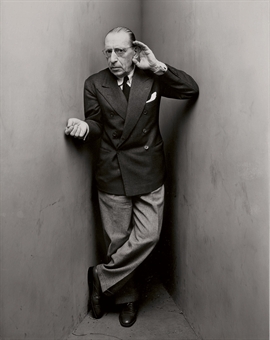
Irving Penn, renowned photographer, known for his fascinating portraits in black and white, and depicting people as mere shapes. He sees, geometrically, how people can look, and bases his pictures on these shapes. He also adds props sometimes to help with this. He may add bulky carpet, chairs, fabric from the model’s clothes, or even the model’s body, to turn his work into art with shape and structure. I had the chance to interview Mr. Penn to talk about a new portrait of his. It is of an older man, standing in a corner of a room, with one hand in an awkward fist, and the other cupping his ear. Irving Penn has so much to portray just in the body positions of his models.
The picture that I am talking about is one of several more portraits with the model placed in a make-shift corner. Penn elaborates further: “I started using this technique when I shot some portraits for Vogue in 1948. I would create a corner for my model by pushing two white panels together. This created a very sharp corner for the model to stand in. Some of my models, like Georgia O”Keefe, felt very constricted in the small space and felt like it took away from them. It made them feel unlike themselves. Some used it to their advantage and fit the structure with an ease, which gave the picture more of a calming mood.”
“A good photograph is one that communicates a fact, touches the heart and leaves the viewer a changed person for having seen it,” quoted by Irving himself. The kind of art that he wants to produce is the kind that changes people and what they get from the picture. We can definitely say that Irving Penn has achieved this through his lifetime of fabulous achievements. He has created a kind of portraiture that artists like Platon are changed from, and base much of their work on his style.
Penn’s work has been in Vogue magazines all around the world. He was also named one of “The World’s 10 Greatest Photographers” in 1958. His style is quite intriguing and creative for his time. Several photographers today owe him for thinking outside the box when it came to portraiture.

Final Print

http://www.christies.com/lotfinderimages/d50540/d5054050l.jpg

In the interview of his new portrait, Platon coolly tells me of how it all started for him. “Much of my influence came from my parents. My mother was an art historian, and my father was an architect. Much of our lives revolved around art. Although I took a different path with photography, I still learned a great deal growing up around this art culture.” Not only in his household did art teaching take place, but also at St. Martin School of the Art in Great Britain, and the Royal College of Art after that. In 1992, he won the acclaimed award of British Vogue’s “Best up-and-coming Photographer”, which shed light on how far this artist could go in the future. In this magazine, he was able to produce both fashion and portraits, allowing him to show off his versatile talents.
Some of his recent portraits display disproportioned people strewn against a white background, while the model has intense lighting on certain parts of their face. The people appear to be disproportioned in that someone’s hand is five times larger than their head. This effect if made by the positioning of the model’s body in respect to the camera; at an angle of the camera. One of his portraits is of Ray Davis, a musician. This portrait focuses on the distortion of his arms and plays this effect with his face. It truly is a modern twist on portraits. Platon is giving us more depth to the picture, by incorporating shadows and texture and shapes. This also gives the model, Davis, a very secretive and mysterious look. Much of Platon’s portraits are similar in style to that of the infamous Irving Penn. There is a parallel in the structure of the pictures: bold shadows and intense shapes and figures created by the models.
Platon has been taking portraits for almost 20 years now and has worked with some well known publications. To name a few: Rolling Stones, Vanity Fair, GQ, and The New Yorker. He has even done some advertisements with Exxon Mobile, Nike, Verizon, and Rolex. Just by looking at some of the people he has worked with shows his diversity and ability to adapt to his employer, whether it is an oil company or high top fashion.
Mr. Platon now resides in New York, working for the New Yorker. He has had a solo portrait exhibition at the Milk Gallery in the same city. The quote that Platon left me with at the end of our interview dealt with his outlook on his work as an artist: “I never publish anything that I am not proud of. For me, experimenting with different techniques helps me develop as a photographer, and can sometimes the outcome can blow you away.”